The Dallas Cowboys are 4-6, coming off a game where they allowed 584 yards of offense, and have decided to make a change to their defensive coaching staff. Not exactly where you want to be heading into Week 11.
Following Sunday’s 46-40 loss to San Francisco, Brian Schottenheimer announced that Mike Pettine would take over defensive play-calling duties from Christian Parker, who will remain the team’s defensive coordinator.
The good news for Dallas is that the Tennessee Titans are coming to town with a 1-8 record and one of the worst defenses in football. But before we pencil in a Cowboys victory, it’s worth mentioning that Tennessee’s offense has started showing some improvement.
With seven games remaining and the NFC East still within reach, Dallas has an opportunity to get back on track. But Sunday’s matchup will also give us our first look at whether changing the voice calling plays can make a difference for a defense that desperately needs one.
Tennessee’s Offense: Cam Ward Finding His Rhythm
The Titans’ offense hasn’t exactly been lighting up scoreboards this season, but second-year quarterback Cam Ward has shown signs of improvement in recent weeks.
Ward has thrown four touchdowns and just one interception over his last two games. More importantly, Tennessee has started making adjustments to how it operates offensively.
One of the biggest changes has been its increased use of the no-huddle offense.
According to Next Gen Stats, Tennessee has used no-huddle on 39.7% of its offensive plays since Week 7, the highest rate in the NFL. Against Jacksonville, that number climbed to 49.1%, the highest single-game rate by any team this season.
Interestingly, Tennessee isn’t necessarily snapping the football immediately. The Titans are using the no-huddle to get aligned, evaluate the defense and give Ward more time to recognize what he’s seeing before the snap.
And the results have been encouraging.
Since Week 7, Ward has averaged 8.7 yards per attempt in no-huddle situations compared to just 5.0 yards when Tennessee huddles. He’s also generated an explosive passing play on 22.4% of those no-huddle dropbacks, well above the league average of 13.5%.
Ward has also improved his ability to get the football out quickly. His average time to throw has dropped from 3.00 seconds last season to 2.80 seconds this year, helping reduce his sack rate from 8.9% to just 4.4%.
Tennessee has also incorporated more play-action concepts. Against Jacksonville, Ward used play action on a season-high 35.7% of his dropbacks, completing 10 passes for 125 yards and a touchdown. Wide receiver Elic Ayomanor was particularly effective, catching all four of his play-action targets for 71 yards.
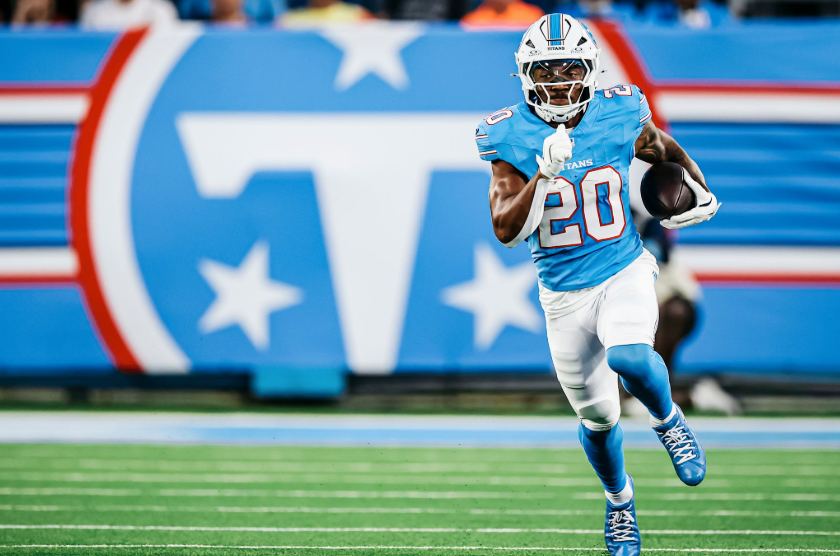
But the most familiar name in Tennessee’s offense is former Cowboys running back Tony Pollard. Pollard has been especially effective running outside the tackles, averaging 4.3 yards after contact per carry on those attempts, the highest mark among qualifying running backs.
That’s concerning considering Dallas has allowed an NFL-worst 5.9 yards per carry on designed runs outside the tackles.
Pollard has also been productive on power concepts, gaining 160 yards and two touchdowns on just 21 carries.
Between Ward’s improved passing efficiency and Pollard’s ability to create yards after contact, Tennessee has more ways to attack Dallas than its record might suggest.
Tennessee’s Defense: Opportunities for Dak Prescott
If there’s one area where Dallas should feel comfortable entering Sunday’s game, it’s the matchup between its passing offense and Tennessee’s secondary.
The Titans have struggled defensively throughout the season, particularly when bringing additional pressure.
According to Next Gen Stats, Tennessee has allowed an 80.8% completion percentage and 9.7 yards per attempt when blitzing, both the worst marks by any defense in a season since tracking began in 2016.
And while Robert Saleh’s defense doesn’t blitz particularly often, those numbers suggest opponents have consistently found ways to take advantage when Tennessee sends extra defenders.
That presents an interesting matchup for Dak Prescott.
Prescott has faced 74 defensive-back blitzes this season, the third-most in the NFL, without taking a single sack on those plays. Tennessee has also struggled to generate pressure without sending extra rushers. Since trading defensive tackle Jeffery Simmons, the Titans have generated pressure on just 11.3% of dropbacks using a four-man rush across their last two games.
The absence of Simmons has been noticeable, although edge rushers Jacob Martin and Jermaine Johnson II remain players Dallas will have to account for.
Martin leads Tennessee with 7.5 sacks, converting 26.8% of his pressures into sacks, the fifth-highest rate among qualifying defenders.
Dallas will also be without rookie right guard Tyler Booker, who suffered a high ankle sprain against San Francisco. Before his injury, Booker had allowed pressure on just 5.2% of his pass-blocking snaps, ranking fifth among qualifying right guards.
Still, Tennessee’s secondary presents some favorable matchups for Dallas’ receivers.
Cornerback Alontae Taylor has allowed 33 receptions on 34 targets this season, a remarkable 97.1% completion percentage. Meanwhile, Joshua Williams allowed eight receptions for 128 yards and two touchdowns against Cincinnati earlier this season.
George Pickens and CeeDee Lamb have combined for 1,650 receiving yards and 13 touchdowns, giving Dallas one of the most productive receiving duos in football.
For comparison, Tennessee’s entire wide receiver group has combined for 1,237 yards and six touchdowns.
The Cowboys have the personnel to challenge this secondary, especially with Prescott coming off a five-touchdown performance against San Francisco.
What This Game Means for Dallas
Sunday will be our first opportunity to see what Mike Pettine brings to the Cowboys’ defense as the primary play-caller.
And while nobody should expect an entirely different defensive scheme in a matter of days, there are some things worth watching.
Dallas has actually improved its ability to generate pressure with four rushers. Since Week 6, the Cowboys have recorded a league-high 13 sacks using a four-man rush, with a 37.1% pressure rate.
The problem has been everything happening behind that pressure.
According to Next Gen Stats, Dallas has allowed 683 additional yards because of missed tackles this season, the second-most in the NFL. The Cowboys have also surrendered 8.9 yards per missed tackle, easily the highest average in football.
That helps explain why a defense capable of recording five sacks against San Francisco still allowed 46 points.
Pettine’s challenge isn’t necessarily finding ways to generate more pressure. It’s finding a way to make the defense more consistent when the ball gets beyond the line of scrimmage.
And the timing of this change is important.
Dallas enters Week 11 with a 28% chance of making the playoffs, according to Next Gen Stats. A victory over Tennessee would increase those odds to 32%, while a loss would drop them to 15%.
With the Giants leading the NFC East at 5-3-1, Dallas’ most realistic path to the postseason remains winning the division.
The Cowboys have a favorable opportunity Sunday against a struggling Titans team, but they’ve also shown that favorable matchups don’t guarantee anything.
The offense has demonstrated it can score points. Dallas ranks fifth in the NFL, averaging 28.6 per game.
Now it’s time to see whether a new voice on defense can help the Cowboys stop giving so many of them back.
Leave a Reply